

Table of Contents
ODI Cricket Faces a Big Question
For the last few years, cricket fans, experts, and former players have been discussing the future of One-Day International cricket. With T20 cricket becoming more popular than ever and Test cricket still holding its traditional value, many believe ODI cricket is stuck in the middle.
Some cricket experts have even suggested reducing ODI matches from 50 overs per side to 40 overs. Their argument is simple: shorter matches could attract younger audiences who prefer fast-paced entertainment and may not want to spend an entire day watching cricket.
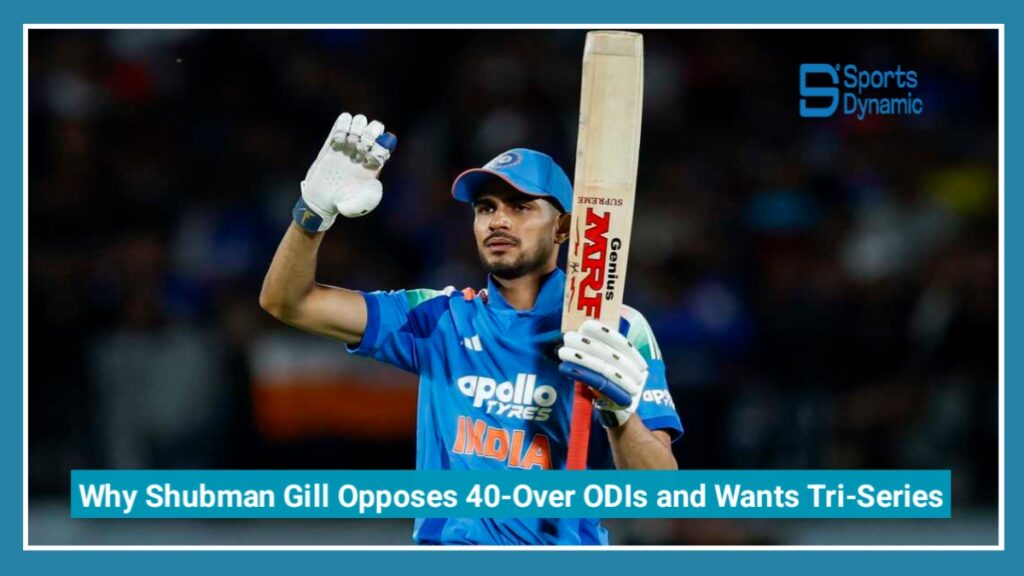
However, India’s ODI captain Shubman Gill is not convinced by that idea at all.
Ahead of India’s ODI series against England, Gill made it clear that reducing the number of overs is not the right solution. Instead, he believes cricket boards should focus on making ODI cricket more interesting through better tournaments and scheduling.
Why Shubman Gill Doesn’t Like the 40-Over Idea
According to Gill, shortening ODI matches would take away what makes the format special.
He explained that 50-over cricket has its own identity. It is different from both T20s and Test matches. If the format is reduced to 40 overs, the gap between ODI and T20 cricket becomes even smaller, making the two formats look very similar.
Gill feels that one of the biggest strengths of ODI cricket is the way a match develops over time. Teams get enough opportunities to recover from mistakes, build partnerships, plan strategies, and create pressure on opponents.
In T20 cricket, players often have to attack from the very first ball because there is little time to settle in. ODI cricket, on the other hand, allows a balance between aggression and patience. Batsmen can construct innings, bowlers can work on long-term plans, and captains have more tactical decisions to make.
For Gill, that balance is what makes ODI cricket exciting.
The Real Problem Isn’t the Format
Gill believes the issue is not the length of ODI matches but the lack of excitement around many bilateral series.
Today, most ODI cricket is played in two-team series that often don’t carry much significance. Fans usually become fully invested only during major ICC tournaments such as the Cricket World Cup or Champions Trophy.
As a result, many regular ODI series struggle to generate the same level of interest.
Rather than changing the rules of the game, Gill feels cricket administrators should focus on creating competitions that naturally keep fans engaged.
And that’s where his big suggestion comes in.
Bring Back Tri-Series Cricket
Gill believes the return of tri-series tournaments could help revive interest in ODI cricket.
For younger cricket fans, tri-series tournaments were once a regular part of the international calendar. Three teams would compete against each other in a mini-tournament, with the top sides advancing to a final.
These tournaments created excitement because every match mattered. Teams faced different opponents, points tables kept changing, and fans followed the competition from start to finish.
Some of cricket’s most memorable ODI moments came during famous tri-series events in countries like Australia and England.
Gill feels bringing back those tournaments could give ODI cricket a fresh boost without changing the format itself.
Why Tri-Series Could Work Today
The biggest advantage of tri-series tournaments is that they create context.
Modern sports fans love storylines. They enjoy following standings, qualification battles, rivalries, and knockout matches. A tri-series naturally provides all of these elements.
Instead of watching three or four isolated ODI matches between the same two teams, fans would see multiple nations competing against each other over several weeks.
This would make every match feel more meaningful.
It would also give broadcasters more attractive content and offer players the experience of competing in a tournament environment, similar to what they face during World Cups and Champions Trophy events.
A View from the New Generation
Gill’s comments are particularly important because they come from one of the leading players of the new generation.
At just 25 years old, he is already one of India’s most important cricketers and has established himself as a key figure in international cricket.
Many discussions about the future of the sport are usually led by retired players or administrators. This time, however, the opinion is coming directly from a current captain who regularly plays all formats of the game.
That gives his viewpoint extra significance.
Gill understands modern cricket, the demands of international schedules, and what today’s audiences expect from the sport. His suggestion reflects a practical approach rather than a drastic change.
Can ODI Cricket Still Survive?
Despite concerns about its future, ODI cricket continues to produce some of the sport’s biggest moments.
The ICC Cricket World Cup remains one of the most watched sporting events in the world. Major ODI tournaments still attract huge television audiences and create unforgettable memories for fans.
This shows that people haven’t lost interest in 50-over cricket itself.
The challenge is keeping that excitement alive between major tournaments.
Gill believes the answer lies in making ODI cricket more competitive and meaningful rather than shortening matches.
The Bigger Picture for Cricket
Cricket is currently going through a period of rapid change. Franchise leagues are expanding across the world, players are managing packed schedules, and cricket boards are constantly looking for ways to attract viewers.
In such an environment, finding the right balance between tradition and innovation is not easy.
Shubman Gill’s proposal offers a middle ground. It protects the unique identity of ODI cricket while introducing a tournament format that could make the game more appealing for modern audiences.
Instead of rewriting the rules, he wants cricket to rediscover something that worked brilliantly in the past.
Shubman Gill’s rejection of the 40-over ODI proposal has added a fresh perspective to an important debate in world cricket. While some believe shorter matches are the future, Gill feels the real issue lies elsewhere.
For him, ODI cricket does not need fewer overs. It needs more context, more competition, and more excitement.
His idea of bringing back tri-series tournaments may sound old-fashioned, but it could be exactly the kind of innovation ODI cricket needs right now. Whether cricket boards listen or not remains to be seen, but Gill has certainly started a conversation that is likely to continue for a long time.
And if the reaction from fans is anything to go by, many people agree that changing the format isn’t the answer — making the game more meaningful is.
Also Read This:
Who Was Jayden Adams? South Africa World Cup Star Dies Tragically at 25
Spain and Belgium Battle for World Cup 2026 Semi-Final Spot in Blockbuster Quarter-Final
FOLLOW FOR LATEST UPDATES