

Table of Contents
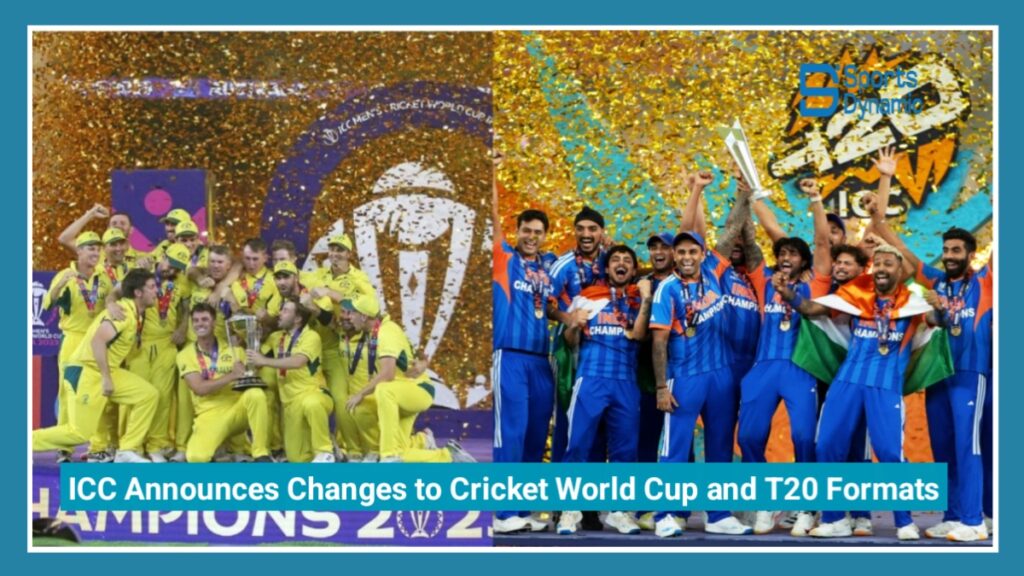
The International Cricket Council (ICC) has announced some major changes to the formats of its biggest men’s tournaments. The decisions were finalized during the ICC Board’s annual meetings in Edinburgh and are aimed at making global cricket events more exciting, competitive, and meaningful from the very first match.
The changes affect the ICC Men’s Cricket World Cup, the ICC Men’s T20 World Cup, and the qualification pathway for future T20 World Cups. According to the ICC, the goal is to increase the importance of every game, create stronger competition between teams, and provide more opportunities for emerging cricket nations to shine on the world stage.
Big Changes Coming to the ICC Men’s Cricket World Cup
One of the biggest announcements concerns the ICC Men’s Cricket World Cup. While the tournament will continue to feature 14 teams, the format has been completely redesigned.
The ICC believes that in previous editions, some matches in the early stages did not have enough significance. The new format aims to ensure that every game matters and that teams face pressure from the beginning of the competition.
How the New World Cup Format Will Work
The tournament will now have three competitive stages before the final.
Round 1: Super Series
The teams ranked 12th, 13th, and 14th among the qualified nations will compete in a round-robin “Super Series.”
Each team will play against the others, and only the top team will advance to the next stage.
This means that lower-ranked teams will have to earn their place in the main phase of the tournament, adding immediate intensity and consequence.
Round 2: Group Stage
The remaining teams, along with the winner of the Super Series, will be divided into two groups of six teams each.
A total of 30 matches will be played during this stage.
The top three teams from each group will qualify automatically for the next round. In addition, the best fourth-placed team across both groups will also advance.
This creates a highly competitive race for qualification because teams cannot afford many mistakes.
Round 3: Super 7
The seven qualifying teams will enter a single round-robin stage called the “Super 7.”
Every team will play against the other six teams, resulting in 21 matches.
The top four teams in the Super 7 standings will progress to the semifinals.
The semifinals will follow the traditional format:
- 1st vs 4th
- 2nd vs 3rd
The winners will then meet in the final to decide the world champion.
Why the ICC Made These Changes
According to the ICC, the revised structure creates greater context and importance for every match.
Instead of teams having room for multiple poor performances early in the tournament, every game can directly influence qualification chances.
The ICC also believes that the Super 7 stage will produce more high-quality contests between top teams, giving fans a stronger tournament narrative leading into the knockout rounds.
ICC Men’s T20 World Cup Gets a Fresh Look
The ICC has also approved a major restructuring of the Men’s T20 World Cup.
The T20 format has played a huge role in expanding cricket globally, and the ICC wants to continue encouraging participation from emerging nations while maintaining a high standard of competition.
The changes were inspired partly by the performances of smaller cricket nations in the 2026 T20 World Cup, where several emerging teams showed they could compete against established powers.
New Group Stage Format
Under the previous format, the tournament consisted of four groups of five teams, with the top two teams from each group progressing to the Super Eights.
The new format introduces five groups of four teams each.
This change reduces the number of group-stage matches from 40 to 30.
However, the top two teams from each group will still qualify for the next stage.
The ICC believes this structure will make every group match more important because teams have fewer opportunities to recover from defeats.
Introduction of the Super 10 Stage
One of the most significant changes is the replacement of the Super Eights with a new Super 10 stage.
The ten qualifying teams will be divided into two groups of five teams each.
This stage will feature 20 matches, significantly more than the 12 matches played in the old Super Eights format.
The ICC expects this to increase the number of high-profile clashes between strong teams while also giving emerging nations more chances to compete against elite opposition.
New Eliminator Matches Add More Drama
Perhaps the most exciting addition is the introduction of Eliminator matches.
In the new format:
- The team finishing first in each Super 10 group qualifies directly for the semifinals.
- The teams finishing second in each group will play an Eliminator against the team finishing third in the opposite group.
These Eliminator matches will determine the remaining two semifinalists.
This system means that teams finishing second or third still have a path to the semifinals, keeping qualification races alive until the final group matches.
For fans, this should create more drama and suspense during the closing stages of the tournament.
New Qualification Pathway for T20 World Cup 2028
The ICC has also confirmed details regarding qualification for the 2028 T20 World Cup.
A special provision has been made for Scotland, which will enter directly into the Europe Regional Final due to exceptional circumstances linked to the 2026 tournament.
Teams that participated in the 2026 T20 World Cup but failed to gain automatic qualification will move directly into the Global Qualifier.
Additional spots in the Global Qualifier will be allocated through regional competitions:
- Africa – 2 teams
- Asia – 2 teams
- Europe – 2 teams
- Americas – 1 team
- East Asia-Pacific – 1 team
From the Global Qualifier, the highest-ranked team from each region and the next three best-performing teams overall will qualify for the 2028 T20 World Cup, subject to minimum performance requirements.
New Global Tournament for Associate Nations
Another important proposal approved by the ICC is the creation of a new 16-team global tournament.
This competition is intended primarily for associate member nations and would act as a major event before the T20 World Cup.
The ICC believes such a tournament would provide associate nations with more meaningful international cricket and help improve overall standards.
The proposal has received support from the ICC Board but will undergo further review by the Finance and Commercial Affairs Committee before receiving final approval.
What These Changes Mean for World Cricket
The ICC’s latest reforms represent one of the most significant overhauls of global cricket tournaments in recent years.
By increasing the importance of every match, introducing new qualification opportunities, and creating additional knockout-style contests, the ICC hopes to make its marquee events more engaging for players, broadcasters, and fans.
For emerging cricket nations, the changes offer greater opportunities to compete against stronger opposition and potentially reach deeper stages of major tournaments.
For supporters, the new formats promise more high-pressure games, more meaningful contests, and more excitement throughout the tournament rather than only during the knockout stages.
If successfully implemented, these changes could redefine the structure of international cricket competitions and make future ICC tournaments more competitive and entertaining than ever before.
Also Read This:
FIFA World Cup 2026: France and Spain Ready for Epic Semifinal Battle in Dallas
India vs England 1st ODI 2026: Axar Patel and Washington Sundar Lead India to Six-Wicket Victory
FOLLOW FOR LATEST UPDATES