
Table of Contents
India vs Netherlands: India Post Competitive 193/6 in Ahmedabad
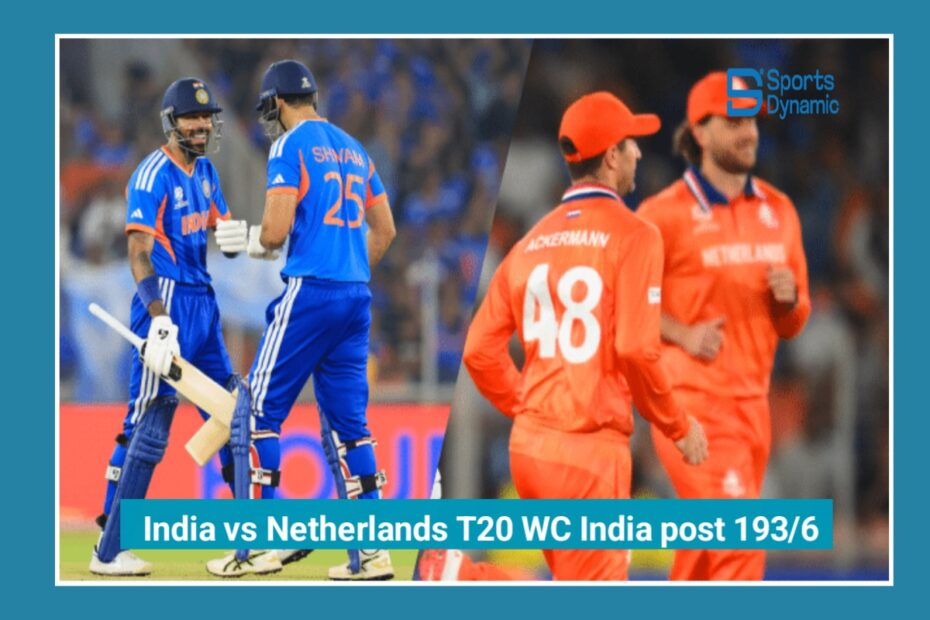
On February 18, 2026, at Ahmedabad’s famous Narendra Modi Stadium, India put up a strong batting show in their final Group A match of the ICC Men’s T20 World Cup 2026 against the Netherlands. Batting first, the Indian team managed to score an impressive 193 runs for the loss of 6 wickets, giving themselves a solid chance to control the match.
The weather was bright and sunny, and the pitch looked perfect for batting. Taking advantage of these conditions, Indian players played with confidence and maturity. They mixed powerful shots with smart running between the wickets, which helped them keep the scoreboard moving throughout the innings.
After winning the toss, captain Suryakumar Yadav decided to bat first. His idea was clear — use the fast outfield and flat pitch to score big and put pressure on the Netherlands from the start. The decision proved to be a good one, as India kept building partnerships and maintained a healthy run rate.
This match was very important for both teams. For India, it was about gaining momentum before moving into the Super 8 stage and boosting team confidence. For the Netherlands, it was a must-win situation, as they were hoping to create an upset and keep their campaign alive.
Overall, India’s balanced and disciplined batting performance helped them post a challenging total, setting the stage for an exciting second innings and keeping fans on the edge of their seats.
India’s Batting Effort: Balance of Aggression and Stability
India’s innings started in a careful manner, as the batters tried to settle down and understand the pitch. However, things didn’t go as planned in the beginning. Opener Abhishek Sharma was dismissed very early and went back without scoring a single run. This was another disappointing moment for him in the tournament and put extra pressure on the rest of the batting lineup.
After losing an early wicket, the Indian team became more cautious. The Netherlands bowlers were bowling tight lines and lengths, making it difficult to score freely. At this stage, India needed someone to take responsibility and bring some momentum back.
That’s when wicketkeeper-batter Ishan Kishan stepped in and played a quick and attacking knock. He scored 18 runs from just 7 balls and hit a few stylish boundaries. His short but energetic innings helped lift the team’s mood and showed that India was ready to play positive cricket.
But the real turning point of the innings came when Shivam Dube took charge. He played with confidence and maturity during a difficult phase. Dube didn’t waste loose balls and regularly found the boundary. At the same time, he made sure not to take unnecessary risks. His half-century became the backbone of India’s innings and helped the team maintain a strong run rate.

Captain Suryakumar Yadav also played a useful role. He showed some of his trademark creative shots and added valuable runs to the scoreboard. Although he couldn’t stay till the end and got out earlier than expected, his contribution helped keep the momentum going.
Thanks to the solid foundation built by Dube and others, the Indian team was well placed for a strong finish. In the final overs, experienced players like Hardik Pandya and Rinku Singh took charge. They played smartly, found gaps in the field, and hit important boundaries when needed.
With quick running between the wickets and powerful shots in the death overs, India finished their innings at 193 for 6 in 20 overs. On this ground and under evening conditions, it was a very competitive total that put the Netherlands under serious pressure.
Key Performances and Turning Points
Shivam Dube turned out to be the biggest hero for India in this match. When the team was under pressure after losing early wickets, he stayed calm and played a responsible innings. He handled the middle overs really well and made sure India didn’t lose control of the game. At the same time, he didn’t play too defensively. Whenever he got a loose ball, he punished it with confidence. His fifty was a perfect mix of smart cricket and attacking shots, and it became the backbone of India’s strong total.
Ishan Kishan also played an important role, even though his stay at the crease was short. After the early wicket, India needed quick runs, and Kishan delivered exactly that. He played fearlessly and scored 18 runs from just 7 balls, hitting some beautiful boundaries. His fast cameo gave India early momentum and lifted the team’s energy. Even though he got out soon, his knock helped set a positive tone.
For Abhishek Sharma, however, it was another disappointing day. He was dismissed without scoring once again, making it his third duck in a row in this World Cup. This has become a worrying sign for India, especially with important knockout matches coming up. His repeated failures at the top of the order have put extra pressure on the middle-order batters, and the team will hope he finds form soon.
On the bowling side, the Netherlands showed good discipline and fighting spirit. Their attack, led by Logan van Beek, kept things tight for most of the innings. Van Beek bowled with good control, picked up key wickets, and made Indian batters work hard for their runs. Along with his teammates, he maintained pressure by bowling in the right areas. Thanks to their effort, the Netherlands stayed in the game and gave themselves a fighting chance despite India’s big total.
Match Atmosphere & Strategic Observations
The match was played at the world-famous Narendra Modi Stadium, the largest cricket stadium in the world, and the atmosphere was truly electric. Thousands of fans filled the stands and enjoyed every moment of this exciting T20 contest. It felt more like a cricket festival, with cheers, flags, and nonstop energy all around.
The pitch behaved well throughout the innings. It had good pace for batters to play their shots freely, but at the same time, it also helped bowlers who stayed disciplined and bowled in the right areas. This balance made the contest interesting and competitive.
India’s decision to bat first looked like a smart move. The team clearly wanted to put a big score on the board and then put pressure on the Netherlands during the chase under the floodlights. From the start, India focused on building their innings carefully instead of going all out.
Their batting plan was quite clear. In the early overs, they tried to rotate the strike and avoid taking too many risks. In the middle overs, they slowly increased the tempo and started attacking more. This strategy worked well for most of the innings, although they lost some momentum after a few important wickets fell.
Once Shivam Dube and other batters found their rhythm, runs started flowing more easily. Boundaries came regularly, and the scoreboard kept ticking. This showed how strong and deep India’s batting lineup is, with many players capable of stepping up when needed.
On the tactical side, India also did well with their bowling and fielding plans. The bowlers were rotated smartly, and different variations were used to confuse the Dutch batters. Quick changes in bowling and field settings kept the Netherlands guessing and made it hard for them to settle.
The field placements were aggressive and well thought out. Indian fielders tried to cut off easy singles, force dot balls, and create pressure. This approach pushed the Dutch batters into playing risky shots, which increased the chances of mistakes.
Overall, India looked well-prepared and confident, both in batting and in their game strategy, making this match a strong display of their planning and execution.
Looking Ahead: Chase, Context & Implications
With 193 runs on the board, India will be feeling quite confident about their position in this match. Considering the strong bowling attack they have and the experience in their squad, this total looks good enough to defend. The players know that if they bowl well and stick to their plans, they have a strong chance of putting pressure on the Netherlands.
For the Dutch team, the chase will not be easy at all. They will need to play brave cricket but also be very careful at the same time. Scoring at a high run rate is important, but taking too many risks could lead to quick wickets. So, they will have to find the right balance between attacking shots and smart decision-making.
For India, this final group match in the ICC Men’s T20 World Cup 2026 is not just about winning. It is also a chance to test different player combinations and give some confidence to the bench players before the tougher matches in the Super 8 stage. These small experiments can be very useful when the knockout rounds arrive.
Keeping the winning momentum alive and building self-belief in every department — batting, bowling, and fielding — will be very important for India in the coming matches. A strong performance here can boost the team’s morale and help them move forward with confidence.
Fans and cricket experts are watching this match closely. Everyone is excited to see how the Netherlands will respond to such a big target. The result of this match can affect group rankings and future matchups, which makes it even more interesting.
India’s batters have already done their job by setting a tough target. Now, the responsibility lies with the bowlers to defend it and finish the match strongly.
To sum it up, India’s innings in this match ended on a positive note at 193 for 6, thanks to smart batting, strong partnerships, and disciplined play. Even though the top order struggled a little, the middle and lower order stepped up at the right time and made sure the team reached a competitive score.
With the chase underway and the tournament moving into an exciting phase, this match has added more thrill and excitement to cricket’s biggest T20 festival. Fans can now look forward to a gripping finish.
Also Read This:
T20 World Cup 2026: England Seal Super 8 Qualification with 24-Run Victory Over Italy
Live Update: India vs Netherlands India Win Toss at Ahmedabad T20 Match
FOLLOW FOR LATEST UPDATES